Analysis of BlueMoon Exploit Kit Used by Multiple Nation-State Actors
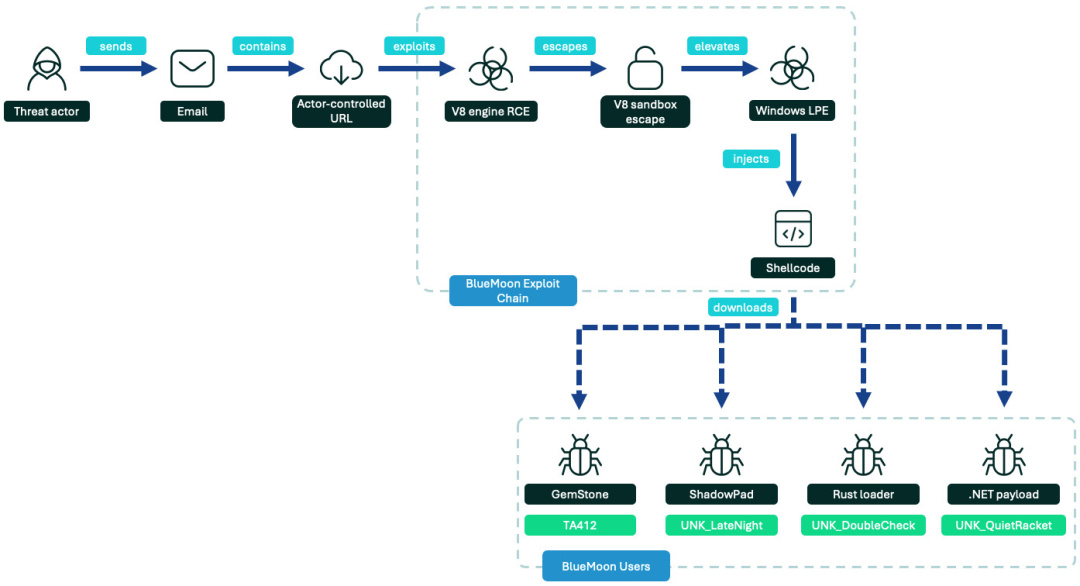
Proofpoint's recent analysis has unveiled that four nation-state actors have adopted the BlueMoon exploit kit within a mere 12 days of its first observed use. This kit, which exploits vulnerabilities in both Chrome and Windows, has drawn attention from major cybersecurity entities, including Google’s Threat Intelligence Group, Microsoft’s MSTIC, and Volexity, all of whom contributed to the investigation.
The report indicates that the first group to utilize the BlueMoon exploit kit was the China-aligned threat actor TA412, also known by aliases such as JungleBamboo and APT31, on August 28, 2026. Following this initial deployment, several other espionage-driven clusters began employing BlueMoon, predominantly linked to actors suspected of having ties to China. However, the report notes that the exploit kit's usage may extend beyond China-aligned groups, as some instances remain unattributed.
BlueMoon exploits a chain of three vulnerabilities, including CVE-2026-85046, a type-confusion flaw in Chrome’s V8 JavaScript engine, which allows attackers to manipulate memory addresses and execute arbitrary code. This is complemented by a V8 sandbox escape, which enables attackers to overwrite WebAssembly function bodies with malicious code. The final component of the exploit chain, CVE-2026-85880, is a Windows kernel local privilege escalation that allows attackers to elevate their access from a sandboxed environment to the broader system, enabling them to execute arbitrary commands.
At the time of the observed activity, both V8 vulnerabilities were classified as “patch-gap” zero-days, meaning they were known vulnerabilities that had been fixed in public upstream Chromium code but remained unpatched in the stable versions of Chrome available to users. The rapid weaponization of these vulnerabilities was facilitated by the exploit kit developers utilizing publicly available patches to construct their attack vectors.
Indicators of AI Influence in Exploit Development
The report further suggests that while there is no definitive evidence confirming AI-assisted development of BlueMoon, several indicators point toward this possibility. These include extensive logging capabilities, a markdown handover document, and detailed comments that outline debugging processes and implementation decisions. The default configuration of the exploit chain also reflects a significant departure from typical operational security practices, indicating a focus on rapid deployment rather than stealth.
The initial deployment by TA412 targeted U.S. NGOs and various companies in the mining and trading sectors, using phishing emails disguised as outreach from university students seeking internships. The malicious payload, dubbed GemStone, masquerades as an AI-powered browsing companion and is capable of capturing sensitive data such as keystrokes and browsing history.
Why It Matters
Following TA412's activities, other clusters like UNK_LateNight and UNK_DoubleCheck began targeting U.S. defense and aerospace firms, employing similar tactics to deliver malicious payloads. The BlueMoon exploit kit's rapid adoption and deployment across multiple threat actors highlight a concerning trend in cybersecurity, where the barriers to developing sophisticated exploits are diminishing, potentially due to advancements in AI technology.
The implications of this development are significant, as the BlueMoon exploit kit represents a high-value capability that has been quickly weaponized and shared among various threat actors. This situation underscores the need for heightened vigilance and proactive measures among organizations to mitigate the risks associated with such rapidly evolving cyber threats. As the landscape of cybersecurity continues to evolve, the intersection of AI and exploit development will likely remain a critical area of concern for security professionals.