Exploring the Future of Model-Oriented Programming Languages
Thirteen years ago, I developed what I believe to be the first fully featured model-oriented programming language and integrated development environment (IDE). This technology, known as Mo+, was effectively utilized in various enterprise projects. However, I struggled to gain wider acceptance for these ideas. After leaving my software engineering career six years ago to pursue shipbuilding in Scandinavia, I continue to reflect on the potential of model-oriented programming.
The primary aim of this article is not to promote my technology but to inspire further research and development in model-oriented languages. I welcome any insights into ongoing research in this area.
I am convinced that model-oriented programming languages hold significant potential, especially in the context of artificial intelligence. This article aims to encourage a deeper exploration of this potential.
At its core, a model serves to concisely represent something larger or more complex. For model-oriented programming, we need a clear electronic definition of a model, which can be described in terms of structure and data. The structure outlines the rules or schema of a model, which is inherently hierarchical. A model is populated with data that conforms to this structure.
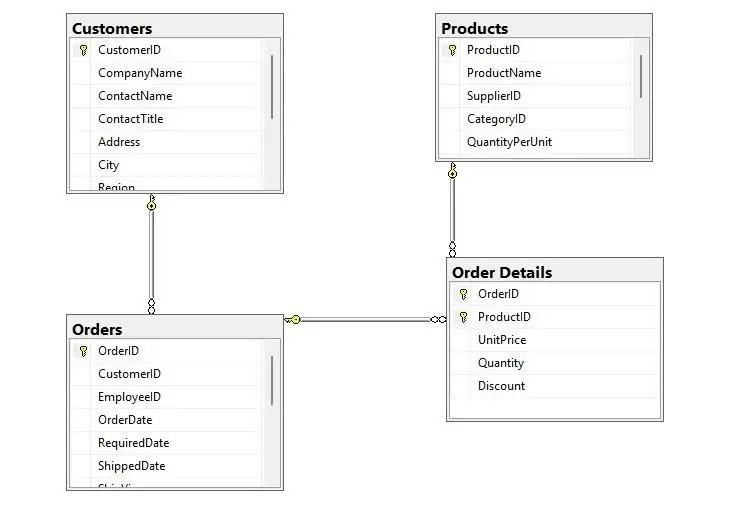
A model structure can be defined using nodes and attributes. For example, the schema of a relational database can be represented hierarchically, with nodes such as database, table, column, and key. This hierarchical structure allows for complex model definitions that remain manageable and intuitive.
In this article, I will use a simplified restaurant scenario to illustrate how model-oriented programming can be applied. This scenario will serve as a basis for discussing various model structures and programming approaches.
The definition of modeling can be understood as the process of populating a model structure with data. Model-Oriented Programming (MOP) refers to the utilization of a model to create and maintain a system, while Model-Oriented Development (MOD) encompasses both modeling and MOP.
I propose several forms of MOD, including informal, inline, coupled, and decoupled MOD. Informal MOD involves using non-standard models, while inline MOD leverages frameworks like Entity Framework or Angular to define models directly in code. Coupled MOD typically employs UML diagrams for system design, whereas decoupled MOD focuses on outlining requirements without tying them to specific components.
Exploring MOP Language Capabilities
The potential for MOP languages to support these various forms of MOD is substantial. A MOP language could be developed to accommodate informal models, allowing teams to represent their ideas electronically, albeit with limited benefits. In contrast, MOP languages designed for coupled and decoupled MOD could streamline the modeling and coding processes, enhancing overall efficiency.
To explore the potential features of MOP languages, we must consider their application in different contexts. MOP can be used for transitional purposes, helping to create and maintain target system environments, or for modeling purposes, focused on maintaining the structure and data of a model. The features required for MOP languages will vary based on their intended application.
In comparing MOP languages to traditional object-oriented languages, it becomes clear that MOP offers unique advantages. For instance, incorporating model structure directly into the language grammar simplifies coding, allowing developers to interact with model data without the need to instantiate complex structures.
As we delve into coding examples, we will highlight how MOP languages can facilitate efficient programming sessions, where model structures are known and data is read-only. This approach enhances the ease of traversing model data hierarchies, enabling developers to access information seamlessly.
The grammar of a fully featured MOP language should include the hierarchical model structure, allowing for straightforward interactions with entities, relationships, and properties. This structure enables developers to reference model data intuitively, enhancing productivity and reducing complexity.
Why It Matters
The potential for MOP languages to support various forms of MOD is vast. By integrating model-oriented principles into programming practices, we can streamline the development process and unlock new possibilities for AI applications. As the field of AI continues to evolve, the importance of model-oriented programming will only grow, making it essential for developers to explore and adopt these innovative approaches.
Understanding and implementing model-oriented programming languages can significantly impact the efficiency and effectiveness of software development, particularly in AI-driven projects. By embracing these methodologies, developers can create more adaptable and maintainable systems, ultimately leading to enhanced innovation in the tech landscape. As we look toward the future, the integration of model-oriented programming into mainstream development practices could redefine how we approach software design and implementation, paving the way for more intelligent and responsive applications in the AI domain.